Examining a comic (AKA what I usually do in my free time)

jueves, noviembre 10, 2011
Personally, after having the TOK lesson on the many different meanings of pictures and words, I thought to myself - "Doesn't this apply a lot to my comics and drawings?" I hate (not really) having to relate this to art (again), but its simply one of the very first things that comes to mind when doing a subject on TOK on both WORDS and IMAGES. Because, funnily enought, comics are very mainly done out from these two.

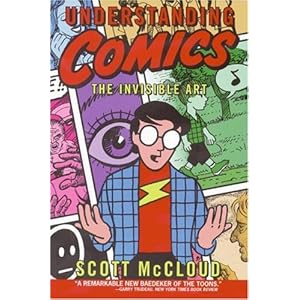
A year ago I went to Philadephia (some part of it which I don't remember) to go to my cousin and her husband's house to stay over for the night. When I arrived I was flabberghasted (really) because of the enourmous quantity of books they possesed, but I was even more delighted to find out that my niece's husband shared a common like with me: comics. He had bookshelves, stacks on the floor, on top of the fridge - everywhere! I could have spent the rest of the summer right there reading away - but I only had one day. I coincidentially picked this fantastic book about comics. Understanding Comics by Scott McCloud. It really was one of the best comic theory books I've ever read (actually, its the only one I've read -.-)


This book was just so fantastic at explaining the very tight connection between words and pictures - especially in the scan above (my favourite bit) where it mentions Rene Magritte's "Treachery of Images" (another fitting example of images and words working to make you double think if what you are seeing IS a pipe or just a drawing/painting of a pipe). 

So enough with that, I picked this comic below to see what i made out of it by just seeing at the images on it.
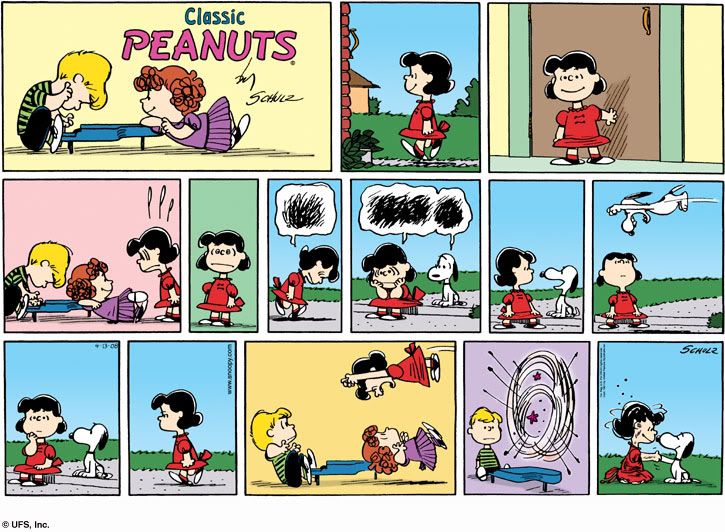
Panel one: Title page. A guy crouched over a piano, playing it/fixing it/sneezing/looking at it for no reason whatsoever/scratching his head/ect. A girl is watching him resting on the piano/she fell on the piano/sniffing the piano/trying to break the piano/etc.

Panel two: A girl walking to a house/ walking towards a brick wall/ hopping on the spot/brushing her feet on the pavement/playing musical statues/etc.

Panel three: A girl gets in a house and shuts the door behind her/she is admiring the door's texture/she supported herself on the door due to dizziness/she is just standing there/etc.

Panel nine: A dog demontrates his plan to attack the other red headed girl/a rabbid dog is attacking the girl/the dog pretends to fly/the dog has been kicked out of his house/etc.

Panel thirteen: A fight between the red headed girl and the girl occurs/their moving so fast around each other it can't even be drawn/a mini storm has appeared on the middle of the room/the artist randomly scribbled the panel/etc.

For me, as a comic artist, I always have to take care on the different poses and faces that I give my charecters so that, when i mix the images with my written script for the comic - it will make some sense for whoever sees it. Sometimes I'm not too successful and people often comment their own take of the comic - which is sometimes quite different from what I initially meant - but its definately a good thing that the people who see it have different views on it. (That, or i really need a lot more practice on it.)

Songs on right now: Crystal Ball - Keane, Supermassive Black Hole - Muse, Every Tear is a Waterfall - Coldplay

Indeed: Words have their way.


So, about this last class (28th Oct. 2011 ;P), we further examined the importance of the mix of words and images or symbols in order to convey an idea or show a situation to a person (inform). So, we began the lesson examining a small comic strip and we were asked to interpret what the images were trying to say (by the way, there were no words included in the comic strip). My partner (Isidro) and me came up with this sentence for it:


"A war has broken out somewhere in an African village and the villagers are being attacked by invading troops."
After writing this and sharing our sentence with all the other pairs, we found out that we all had slightly different outlooks on what was going on in the image. Some of us said that people were being killed, others that it was in the middle of the savannah, others said that the soldiers were coming to help them, and even one pair described the emotional aspects of the image. However, when we were shown the comic with the panels in different order, we found out that it could get a completely different meaning (In this case, the troops were coming to help the villagers from some previous attack or disaster they had...who knows really?).

Following this, we had to pick a question from one subject (Biology, Chemistry or Physics) and answer it with scientific terms. In my case I had to describe what light is:

"Light is a small part of the electromagnetic spectrum. it is composed of three different colours - red, green and blue - all which combine to make white visible light. Light can be reflected, refracted, scattered and absorbed by different components and objects that it finds on its path. It travels with wavelenghts and its speed is of 3x10^18 ms-1." (A whole mouthful of scientific terminology.)
After this we were asked to list words that came up to our mind when hearing the word "light".

Life, creation, day, hapiness, hope, warmth, blinded, strong, powerful, invigorating, ect. 

This, from what i have learnt previously in my English lessons - is called a denotation. A denotation is when a word is described for what it means in a very precise and often scientific way. For example: 

"The Moon is the Earth's only natural satellite. Its distance is three times Earth's diameter and it moves around the Earth as this one spins around its axis around the Sun - hence enabling different faces of the moon to be visible at different stages of the month." (Another mouthful)

However, if you were to describe the moon or a word with a connotation, then the description would be totally different:

The moon holds a ghostly silver woman, perched upon a sea of blackness and stars, its faces gradually unveiling themselves for the human eye to admire (that was quite... bad :( )

So the point about a connotation is that ideas of emotions and relations to the word are brought up to describe it rather than describing it with the exact definition of it. This is why such language it commonly used in poems and novels that try to use literary devices such as similies and metaphors to convey a idea or feeling on the work (the advanteages of English A1 xD)

For me this lesson was really intresting as one can interpret an image in a million ways, but at the same time words can also have the same attribute as they may have a lot of different ways of seeing them depending on the person.

On the last TOK Class: Connections between Words and Symbols/Signs

jueves, octubre 27, 2011
Starting off, some definitions (straight from notes I took on class x) )

Sign: Characteristic of the species - fixed in meaning and immediate place and time.
Symbol: Created through convention (agreement)

So, to resume (not really) what happened in last TOK lesson, we simply saw how words and symbols connected to each other. This was quite intresting because: what if you went to a totally different country that had a symbol you recognized? The only trouble would be,... well, maybe the people of this country might have a different meaning to this symbol (hence, your perception of what it means is wrong in the context of the coutry you're at). This was really interesting as it made me think on how language and culture can affect the way in which visual references are seen in.

After this we were put on pairs to do a quick exercise in which we had to act out a situation to another pair and they would have to figure out what we were trying to say through our gestures and actions.

Isidro and me had to act out a situation in which a really bad maths student is doing a test. This student finds the test really hard and complicated to do, so he finishes it but already knowing that his mark is going to be low. Then the teacher comes over, marks the test and shows the student the really bad grade he got, leaving the kid real dissapointed and worried.

This mini-scene wasn't too difficult to act out to the other pair, so it was quite easy for them to figure it out. However, the other group was given a similar scene to play. The only differences were that: 1. There were abstract concepts involved such as emotions and thoughts - hard to be conveyed simply by gestures & 2. This scene was rather positive (the student was quite good at maths and not pessimistic xD) So, kidding aside - the other pair did find it a lot more difficult to explain only by using acting and no words to support it (nevertheless it wasn't too difficult to figure out because it was really similar to our scene - only more positive and stuff.)

The next thing we did in class was very intresting as I never had put any thought into it until that day. It naver occured to me how certain things couldn't be explained by either words or a set of diagrams alone. Even simple things such as explanation of how to tie your shoelaces has to be done by explaining visually (ie. showing how its done with an actual shoe) and by explaining textually (ie. First you have to grab the laces and....) Whilst doing my set of intructions on how to tie shoelaces I struggled a bit to find appropiate words and sentences to explain what I meant to the others. You can often see how things are explained by joining words and images to give the person a very clear view on what they are supposed to do. This even applies to manuals and cooking books, which commonly join both images and words. This is why I consider that words and symbols couldnt exist without the other as they are very important to support each other when transmitting messages, instructions and ideas to other people.

Noticing words and symbols/signs

So, I thought about what we had learnt at the last TOK class we had. Thinking back to last year (Year 11), I remember doing very similar exercies to the ones we did in class. Mr Sanderson (our past English teacher) would encourage us to pick a scene from a play (in that case it was Absent Friends) and make silent acting or still frames of the scene and have the rest of the class guess. We often used hand gestures (symbols) in order to convey something. For example, if the person had a fist held in front of the other charecter it could be used to represent confrontation and trouble between these two charecters. 

Body gestures also fit into the symbol/sign rules as, you can use them to give the other person an idea of what you're trying to mean without having to say a single word. Someone nodding with their head will tell the other person they agree or that their saying "yes", a thumb held up can be interpreted as a sign of support, an eyebrow raised could mean confusion, and many other things can be held from this point. All in all, images and words (read) are taken in through the eyes and the sense of sight in order to fill in the blanks in case that words aren't available. 

So, back to the actual pictorial symbols and signs, lately when going around the town I've been noticing more and more of these. Some of them aren't even too visible - not because their hidden, but because they seem so normal to our daily lifes that we alreadt overlook them and we immediately react upon seeing them. For instance, if  someone sees a red traffic light flash on, it means that cars on the lane have to come to a halt to the the other cars pass. A green light means to advance and keep on going, and a yellow line means to have precaution when crossing. These are very common to people's lifes, but like always, people aren't born knowing - so indeed symbols and signs are created through agreement and passed down to newer generations by education depending on the place where this takes place.

Sight

jueves, octubre 20, 2011
So I must confess that I have lately (in 1 week) I have gotten quite excited with a new... ermm... TV show I discovered. To put it plainly I've been seeing quite a lot of Doctor Who during the past days as its extremely intresting. Sci-Fi, mixed with facts here and there, history, astrophysics, Sherlock Holmes type of mystery and of course funny overall. Still, the point I wanted to make across with this is that just yesterday I was watching the episode "Vincent and The Doctor". This episode to me was very shocking as it showed a lot of relationship to the sense of sight. 

Not to give any spoilers or anything, but the protagonist and his companion travel to the past to talk to Vincent Van Gogh as he believes he sees a face in one of Van Gogh's paintings. As the episode continues, we are introduced with the main facts of Van Gogh's life which includes his depression and mental issues, his artwork, the villager's distrust of him, his little success as an artist and others. However, the part I thought that was quite intresting is how, at one point, Vincent begins attacking at something the other's can't see. It turns out its a beast that only he can see and from that point on the protagonist and his companion help him to get rid of it. This is a very nice explanation as at the end its discovered that this beast is blind, alone and as it dies it is afraid. Later, Van Gogh says that the beast just attacked out of fear. He says that villagers are unable to see that he's not a bad man like they think he is, this lack of knowledge turns into fear, which consequentially turned into the villagers' agression as they began insulting him and children began throwing rocks at him. Which this I mean how people tend to use their sight to just judge a person for the first things they see on the outside, but they don't take their time to actually look carefully and realize there's much more than what it seems at first sight.


Additonally, as the episode includes an artistic icon, there are many parts in which he talks about the way in which he perceives the world.

Vincent Van Gogh: It seems to me there's so much more to the world then the average eye is allowed to see. I believe, if you look hard, there are more wonders in this universe then you could ever have dreamt of.
The Doctor: You don't have to tell me

Vincent Van Gogh: (Explaining how he sees the world) Look at the sky. It's not dark and black and without character. The black is, in fact deep blue. And over there: lighter blue and blowing through the blues and blackness the winds swirling through the air and then shining, burning, bursting through: the stars! (the sky gradually transforms into van Gogh's painting Starry Night) And you see how they roar their light. Everywhere we look, the complex magic of nature blazes before our eyes.

These two quotes of the epsiode are really relevant to be able to partially explain why I consider sight as an important sense, as it allows people to really focus on whats around them in terms of people or sights. There's always much more hidden to what the eye looks at first sight, making the world be full of meaning and new things to discover and explore, which is why I think that personally sight is very important. 


Listening to: Chances - Athlete, Night of The Hunter - 30 Seconds To Mars, Our Lady Of Sorrows - My Chemical Romance 

5 senses in place... or not?

So last class we discussed the ways in which we adquire, take in and analyze primarily the world around us. The basic ways in which we are able to do this are through the 5 basic senses: Sight, Hearing, Touch, Smell and Taste. All of these often work in colaboration or not entirely separately to be able to understand the different obects around us. All of the senses are equally important to some extent, but it really depends on the person invoved in what sense they give priotity to. 

To continue with what we learnt in class, we did a quick exercise on how little we focused on things on our daily lifes. People could get divided into 4 types on the way they pay attention 1. Either zone out submerged on their own thoughts and plans 2. Taking in detail and external sounds non-related to what they should be paying attention to 3. The ones that pay 100% attention all the time to what they are supposed to be paying attention to 4. All of the above merged. I would consider myself as a person who pays attention in the surroundings and my thoughts as well as largely on what I'm supposed to pay attention to. I tend to oscilate between these three states, but I mostly focus on what I should be doing more than anything else. This is why the excercise of closing our eyes and taking in the sounds of the school was an extremely intresting one as I was able to separate the focus of the current subject onto one that focused more on the external environments.

Its quite curious how people often ignore the feelings of pressure all around us, as the body seems quite accustomed to all of these different pressures and senses being constantly present. This is why the brain just omits them, making the irrelevant anymore. I never really thought about it until that day.

Anyhow, the question that was of most interest to me was "If I had to lose 1 of my sense, what would it be and why?" This was a very intresting question. I first thought about sight. Even though people say that losing sight would be better than losing any of their other senses, I wouldn't like to lose my sight. This is because personally for me (as a person who loves art), sight is one of those things that really allows me to see things - literally of course. Its quite difficult to explain the way i see it. For example, every day that my dad drives me to school I notice the colours and the strong vibrance and wonder of the landscapes I view. Even thought I've been travelling back and forth from the school to my home for the past 11 years of my life, each day I discover new things. Once I noted that there were lots of bluebell-like flowers all the way down the road, in other ocasion I saw how there were some light ripple effects underneath the car bridge over the river, in other times I see how the sun causes the clouds of the evening to turn of different shades and of colours that seem impossible in your mind. So to me, sight is a way of seeing and analyzing a lot of things beyond first sight. Everyday things hide too many things, but they're all at plain sight - you just have to learn to be patient and  truly observant to actually realize beyond first appearances. I would be the most afraid to lose this sense as, even though I've seen colours and I know them already and all, there's still so much to see and be discovered -  from colours, to landscapes, to people and others.

Moreover, I would be almost equally uneasy of having to lose my hearing sense as one of the things that really takes a larger part in my life is music and sounds all around me. The sense of hearing allows me to be aware of my immediate surroundings, probably better than sight, but it doesn't allow me to immediately notice a lot of things like I would with sight. Still, if I didn't have my sense of hearing then I wouldn't be able to locate myself in relation with other people and surroundings. Additionally, music and playing guitar is one of the many things that really intrests me and that I really love having in my life. This is because music is able to evoke many strong feelings and thoughts on me whenever I hear it or when I play a song. At times I sort of randomly (not really) end up playing different chords just to practice or relax after school, and there's times where I end up doing complete invented riffs that usually reflect the mood I'm in at the moment. This is why for me music is a way of expressing what I feel and to get knew emotions provoked by other people's music.

The sense that  I really wouldn't mind losing could be the sense of smell as I consider it less important to all of the others. Its not like "I wouldn't care to lose it" - its more like, in comparison to all the other types of senses I see it as a very limited way to perceive the world. The sense of touch and taste can allow us to know about objects in a much broader way than the sense of smell.

I was going to write about...

jueves, octubre 13, 2011
...the relationships between Peru and Ecuador after the "War of CENEPA" and about the fact thay the GOVERNMENT (the people are not to blame) of Peru took a great piece of our territory not many years ago. Nevertheless, after taking a look at Vale's blog, I can see that she already wrote about it - so I will write about other thing instead. Its also related to the sterotypes and ideas that people have about countries and how these affect their views on their habitants. For example, it can be commonly heard lately how people link Colombian people to mafias and drug producing and to FARC and all of that. Its quite common to hear how people think that the USA is full of overweight and overly consumist people that are damaging the climate with CO2 emmisions. Its quite common to relation people living in the Middle East to the events of the twin towers and to terrorism. All of these imposed stereotypes found in relation to the countries show how people often tend to categorize individuals by the country in which they belong and the things they generally say about that type of people.

This often happens because of the lack of informantion given to students from an early age, which limits their knowledge of the different cultures and people in the world. I myself could prove that this was indeed, sadly enough, true. Last summer holidays, when I went to the exhange programme to Cheltenham, we were invited to one of the girls houses in Bournesmouth. That night we stayed over at her parent's house we had dinner with them and they began asking us about our country and its features. All of the sudden, this girl's older brother asked us how it was living in an African country. An AFRICAN COUNTRY. It was rather shocking how his knowledge of countries outside of his own were quite limited. He even said with full confidence after that how he had learnt that our country had been invaded by Chinese people from early days (Ok, we're not invaded - there's only a lot of chinese people that have been migrating to Ecuador to open their own little shops and all xD). He didn't realize he was wrong until we explained that Ecuador wasn't in Africa and that he might have confused it with Equatorial Guinea.

Additionally, lately, every time someone talks about Ecuador they link it to all the FARC and drug selling activity that takes place in Colombia, which shows how the "stereotypes" have been filtering through to the country's own image, making that immigrants in countries such as USA and Spain are often treated badly and discriminated. This shows how the name of a country can adquire a significance based on the actions of few.

Song's I'm listening to: Fairytales - Jon Walker, Clocks - Coldplay, Creep - Radiohead

Name Meanings.

martes, octubre 11, 2011
So for this I actually had to stop and make some research (after the TOK class, of course). In class we discussed if the names we were given at birth had some significance in our lives or not and we were put in pairs to discuss the reasons for why we were given the names we have nowadays.

So first off, my complete name would be: Evelyn Alicia Cañas Correa (check P).

Second: pulling it apart.

Evelyn: I remember asking my father a long time ago why they had chosen that name for me. He simply replied back, "Because its a pretty name!". Of course, me being me, this answer was never enough for me. At the time I loathed my name as it didn't reflect my way of being completely - it only showed the part of me that my classmates knew. I saw the name as a synoymous of "really girly and poilite girl that is always really normal and lives like in a fairy tale". Some parts of this bothered me, as it didn't reflect my personality fittingly (or so I thought... well to some extent - I obviously wouldn't agree with the 'girly' bit xD). So, a few years later (this summer holidays to be exact) I asked again, this time to my mother. She replied, "Well, your father thought it was a pretty name that wasn't too common in Ecuador, so thats that :)" Again, this reply bothered me, but I arrived to the conclusion that yes: My parents did indeed chose the name merely for the fact that it was pretty. In meaning, the name means: (For French - deriving from Aveline) "Little Bird" (In Celtic) "Life or Life Giver".

Alicia: So this name, ever since I was a little kid I relationed it to one of my favourite stories - Alice In Wonderland. What's ironic nowadays is that my friends, knowing that my middle name is Alicia (spanish version of Alice), the taunt me playfully if we're coincidencially in a forest at the time, saying I'm Alice in the middle of wonderland (the forest xD). Despite all of that, I also asked them years ago why they had chosen that name. Once more my dad replied, "Because it was pretty". It was pretty annoying that they had chosen those names for how nice they sounded, so then again years later I repeated the question - this time more successfully. Aparently one of my dad's aunts whom he loved very much and that had passed away long before I was born shared the name - so he decided to give me that name in her memory. The meaning of this name is: (Old German) Noble kind, of the noble sort.

Cañas: Well, as my dad didn't meet much of his family when younger (back in the '40s communications and transports were really quite slow still) he doesn't know the roots of the surname in itself. The only thing I know is that most of my family from my dad's side (the men) were involved heavily with the Ecuadorian army, so I suppose that some military backgrounds could be involved somewhere along the line. Additionally, I know by fact that my grandfather and grandmother came from the coast areas of Ecuador (Vinces, province of Guayas). This would connect to the literal meaning of the surname which is "sugarcanes" as in these parts of the country there are great ammounts of plantations of this type.

Correa: Even though its my mother's name, I'm really uneasy of letting people know that this is my second surname. The president is much to blame in that. Everytime someone finds out they immediately ask me if I'm the president's (Rafael Correa) relative or something. As far as I'm concerned, I'm not (I would rather not be -.-), but people often link me to him whenever they find out, which has turned to be quite annoying at times. As my mother's family lived in the border between Peru and Ecuador (literally just an hour walk from their house to the border), I could speculate that i might have family in Peru and that the name's roots actually did come from the coastal areas (even though I don't like linking myself to the president, its well known fact that his family is from Guayaquil, province of Guayas. This province borderlines with the province of Loja, which is where my mother's family is from O.O) The translation of the surname is "Belt".

(Check P)

So the conclusion I reached after seeing the context of my own names was that they were chosen merely becuase they were really nice in the way they sounded more than anything else. Nevertheless, the fact that one of my relatives was called Alicia just like me is important to me and my father. Its important for my father as its his personal way of remembering his aunt and showing gratitude to her memory by giving me her name. For me its important as it made me feel as if I knew this person even though I never had an opportuniy to meet her, getting me closer to my family roots. In terms of the surname, it can be seen how people instantly try to relate me to the president as soon as they find out. Nevertheless, I consider that the surname keeps all my family closely related as we all share it in some way or another.

Do names even matter?

jueves, octubre 06, 2011
For all I know tomorrow a table could be called a hat, and instead of saying, "Hey! Stop moving the table! I'm writing" I would be saying,  "Hey! Stop moving the hat! I'm writing" In the first place, the names for objects were made so that people could say, for example, "I found this table lying around" and know what the other person meant. If that wasn't too clear enough, its basically so that different people from different backgrounds can relate an object with one common word so that communication of ideas is easier. However, this isn't always effective as the language barriers and even cultural barriers can make the names given to objects be different. For example, when Valeria first came to the school, she had a bit of 'trouble' with making her point across as there were certain "peruvian words" that were different from the Ecuadorian ones. For instance, here in Ecuador we call a sharpener "sacapuntas" (if you defragment the word its basically 'to get out the tip of the pencil'). Meanwhile, in Peru they call it "tajador" (when defragmented it is 'to cut away'). Still, even though the words are quite different in both countries, it doesn't mean that the objects themselves are different in any way whatsoever - they still sharpen the pencils and do what they're supposed to do. 

Its the same with the idea of changing the name of a rose. No matter of what name you label it with, it will still have its natural attributes of smell, sight, touch and its symbolism would still be the same. In other words its essence would carry on. In class we were given a quote from Shakespeare's Romeo and Juliet which is spot on to explain this idea:

Juliet:
"What's in a name? That which we call a rose
By any other name would smell as sweet." - Romeo & Juliet, William Shakespeare, Act 2, Scene 2 
In this case, it wouldn't matter if Romeo Montague would suddently change his surname to Romano as he would still be the same person whom Juliet has fallen in love with. The only issue that they have in the play is how the different families are full of prejudice as the immediately judge the other family because of the acts of one of the members or by past actions. Therefore, in the play it can be shown how these families had grown so attached to the ideas and relationships between the "supposed" way of acting of the other family and the surnames. This could be a link to what we learnt in class as, nowadays, it would be quite difficult to change people's ideas of what objects should be named as, showing the attachment people have to words after many centuries of using these to refer to the different things in the world. 

Where do you live?

miércoles, octubre 05, 2011
This question was one of the many that we were asked in our last TOK lesson. For one part, the question at first sight seemed really easy as it was quite straightforward.However, as the question was asked even more in depth each time, the harder it seemed to get an exact answer. First off:

Where do you live?
A house. -.-
Where's that?
In the streets *insert streetnames here* such and such
Where's that?
In 'El Valle de Los Chillos'
Where's that?
In the outskirts of Quito
Where's that?
In the Province of Pichincha
Where's that?
In Ecuador
Where's that?
In South America
Where's that?
In planet Earth
Where's that?
In the solar system, just between Mars and Venus
Where's that?
In some part of the Milky Way
Where's that?
In the UNIVERSE... -.-
Where's that?
How AM I supposed to know?! O.O

So after a few turns the question got quite... mind riddling as it just could keep on going on forever. Not only that, but there would be different ways of facing this question depending on the backgrounds in which people are born into and the knowledge they have of the world around them and their place in the... universe, I guess *that sounded way too deep and astrological, but its true*. Anyhow, it was a rather intresting question to be asked, not only because we racked our brains thinking of it, but also because it really got me thinking if it would make any difference if I grew up in a place. In my opinion, it would make some difference in your life. Well, not some - more like a really big difference because of the different languages and cultures that are involved in these parts of the world. They have different ways of seeing themselves in relation to the world based on the beliefs that might have passed to them through the different family generations. In fact, this reminds me of how back in the times in which religion dictated most sciences it was thought that the world was actually in the center of the solar system - with the sun and all the other planets and stars spinning around us. The different knowledges they had about the world back then and their culture affected the way in which the saw themselves in the universe.

So conclude, personally because of the many things I've learnt from my family and from school itself I have my personal ideas of where I belong to in the... universe xD Yes, I'm from Quito, Ecuador - a relatively small but beautifully cultural country in the middle of the Northern/Southern hemispheres, at the north ends of South America, in planet Earth, between Venus and Mars in the solar system, somewhere in the vast Milky Way galaxy (only a few many light years away from Proxima Centauri - nearest star), somewhere in the vast, vast universe nearer to the Andromeda galaxy, in some place that is yet unknown to science and religion and that can only be speculated (because nobody really knows whats outside and they probably never will unless they investigate far more) - so then, who really knows?

Triple-thinking everything and the impact small things have on a larger scale

domingo, octubre 02, 2011
So, about last post I made (link), maybe I was overthinking everything just a little bit too much. Its funny how a single phrase you see somewhere (in this case Twitter), mixed with mutual silence, added the fact that you both are a thousand miles away from each other can cause mild to severe misconceptions of what was being said. Or to whom it was being said. Anyways, right now I'm not too sure about what is going on, but I am bound to find out. Lately it seems like everything out there is bound to confuse me epicly in some way or another, leaving me totally dizzy and more confused and annoyed than before (and yes, that includes TOK classes - as intresting as they are, it's got to be admitted that they are very mind riddling *then again, thats the point of it, amongst many other things -.- *). So now, I just got to sit down and think what I'm going to reply back before replying blindly like I did the first time around. Maybe I was just being paranoid and taking the blame on myself with no reason whatsoever like I always do. Maybe its the other way around and this is just to confuse me. Maybe karma is getting back at me for being so slow at replying (the problem is that I often don't know how to address myself at the moment of speaking/mailing/chatting/etc., so I leave it be until I make up my mind properly). Maybe I'm just overreacting a little bit too much to everything. No clue.

Apart from the mind riddling inner conflict if knowing if I'm right or wrong (or both), lately I've been up to something that is helping the community for a greater good... well, maybe thats an overstatement. More like helping a "ecuadorian fandom" community. Trying to bring people of a country together to stand up for a common belief/like/purpose/etc. is not as easy as it seems - especially in Ecuador's case. Unlike in the United States (where people are so united that they celebrate Halloween together and where most neighbours know each other), here in Ecuador that sense of community isn't as strong unless you have something in between to help them bring them all together physically in the first place (i.e. a school, a party, a football match, a race, etc.). In my case, trying to bring people together physically isn't too easy for me because :

  1. I'm not a natural leader - yeah, once in a while I could take this job and whatnot, but it would just be awkward 
  2. I know no one (face to face) who shares this common like with me
  3. School (Can't mix my life between school, graphic designing, art, music and fangrouping - I would have to get a schedual or proper time managing skills)
  4. The only mediums for bringing people together I know are through the internet, announcing stuff on the radio,aaaannndd... thats about it really :(
However, after months (2 months) of ardous work in the blog http://panicatthediscoecuador.blogspot.com/ and on it's Twitter account, it now seems like its all finally working out like I intended to. Yeah, maybe now I have like 3 Ecuadorian followers on Twitter that know about the page, and that may not sound as much - but for me its a good start. Hopefully, if this keeps going on the way it is up to this point and I keep investing my time onto this, I maybe could achieve large things with this (bringing fans together and knowing each other, projects, bringing the band to Ecuador eventually?) and that could possibly give me experience to carry on other things aside from this that are for a greater good for a community rather than to an specific group of people. Nonetheless, I'm very excited from where this is leading to.

Songs currently on: Tonight, Tonight (The Smashing Pumpkins) cover by Panic! At The Disco, The End of the World - Jon Walker, What You Want - Evanescence

Seeing that "Life is Looking Up"

jueves, septiembre 29, 2011
So, this week has been rather... uneventful perhaps? Apart from many tests we have had and the great success I've been getting on most of my subjects, there's really not a lot of things that have been intresting this week. The one thing that has captured by attention lately has been... art. I know that art may be considered as a shallow thing to speak about, since many people think that art just depends on the person grabbing a pencil and drawing something worthy of being displayed on the National Gallery or something, but it is much more than that. I remember that last year we did an activity with Mrs. Williams on the question "What is art?" (in other words a TOK question). To be truthful, it was really difficult for us to come up with a precise definition to it, because there really isn't only 1 deffinition for it at all. Every single person views art in a different way, just like a person might interpret a song as meaning one thing, while the other person might disagree and say that it could mean another. In other words: there's no fixed meaning to it.

I remember how a few months ago (around the start of July), when Ale and I went on the exchange program to Cheltenham, we were taken to see London and I chose to go to some of the art galleries in there to take advantage of my visit in a good way. We first got to visit the National Gallery, which pretty much has what is thought as "traditional art" (in other words artists such as Van Gogh, Matisse, etc.) However, the second art gallery we visited was the Tate Modern, and quite frankly I can say that this one impressed me more. Even though the quality of the National Gallery's collection was pristine and very detailed and traditional, the Tate Modern's collection contrasted this strongly. For one part, on a side of the building there was literally a room which displayed daily life objects on glass stands with the question we had seen at school: "What is art?" 

That display really got me thinking of what could be thought of as art and on what aspect of an artwork was more important: the message or the technique. Some of the artists there might have seemed as if they had no real technque at all, only meaning to their work. However, these past few weeks I've been studying artists that similarly didn't follow the norm of what was considered as art back then and that were risktakers and innovators in the way that they showed their messages. When I tried to immitate a work of art done by Robert Rauschenberg, even though it seemed like a messy mixture of paints and strokes, I found it really challenging to imitate it. That only showed me that even artists that have really simple or messy artwork do have technique, as all of the brush strokes and colours they use are there for a reason: I even think it takes more skill to do a very chaotic looking piece of artwork and managing to retain its meaning.

Robert Rauschenberg's Lichen AKA the artwork
I tried to imitate, but that I found out that it was
more challenging than what it seemed at first
sight.
So now because all of this, I can say that art really depends on the creator of the piece, but it equally depends on the viewer, as the person who made the work has a different way of thinking than any other person in the world. For one person this work (left) might mean how nature is being destroyed, for others it may be a visual resume of the history of humankind, others could describe it as how the painter feels inside and other people could simply dismiss it as a big array of colours and prints with no meaning at all but only with an aesthetic value. 

Songs currently on: Life Is Looking Up - Forgive Durden, All The Right Moves - One Republic, New Divide - Linkin Park

* Picture of Robert Rauschenberg taken from link - artwork belongs to Robert Raushchenberg, "Lichen", 1972

Can we really believe on what other people say?

miércoles, septiembre 28, 2011
This subject we discussed about on the last TOK lesson was really relevant to me personally because of the incidents of the 30th of September, 2010. Almost a year ago, there was a massive protest done by the Ecuadorian police, which almost literally shook the country and that has marked the lives of Ecuadorians that witnessed the events. That may sound a bit too over the top, but it really was a shocking and unforgettable day for all the people of this country - even up to this date. 

What was scarier about that day was that there was a great ammount of uncertainty of what was going to happen that day - literally all the country was badly informed about what was going on with the president in the center of Quito. In this part, the media areas of the country should have stepped in to inform the country on what was going on and the precautions that we had to take to stay safe (as all the police was on "strike" it was the ideal time for delinquents to make their appearance all over the country, taking advantage of what was going on). The tv channels and radio did keep informed the population informed... but just for a while. At around 4 pm all of the tv channel transmissions were cut out and replaced with the government's channel - in other words, that day only the voice and opinion of the government was heard. 

Personally, this caused me to double think if what the government was saying was truthful or not, as they were claiming that the president had been kidnapped and that there was absolutely no chaos on the streets. It was only to be discovered a few days later that they had lied, as many civilians resulted injured from confrontations agains the police and that the president wasn't kidnapped, but that he pretty much "stepped into trouble" himself and ended up trapped between a fight of the police and the military forces. Some people did believe what the government's channel was saying, specially the people that were keen followers of the president and his campaign. On the other hand, there was the people that didn't belive on the channel, as they believed that the information given was biased only to benefit the president.

Now that many years have gone past, the goverment has been getting into trouble with a lot of independent newpapers on Ecuador, such as El Universo. With cases such as this one, the government has been repeatedly arguing and sueing all of the independent media types of the country that have spoken about something related to the 30-S. To date no one is really sure of what did happen that day, so the general population is still unsure if these newspapers are saying the truth or not, as these have been very trusted medias for the past 100 years.

This is why people can be led to believe on things depending on whom it was written by rather than by analyzing the facts and trying to dig deeper onto to the story to discover if the truth is being said or not.


Sometimes it really seems like...

lunes, septiembre 19, 2011
...someone up there wants to make things tougher for you no matter what. It really is something that happens to me quite often, when I am really content and satisfied of where I am at in life and all. Unfortunately some of these things don't last long (then again, not many things last too long *except for radiation and the universe itself perhaps*). Anyways, this week was rather intresting to me, as I got to realize for the second time how difficult it is to keep on talking with someone that lives in a completely different country to yours and that has different expectations of how you should behave as a friend and such.

It can be argued that "pen pals" or in this case "online friends" (in other words, just friends, despite the distance and all) can get really well along when they first write to each other - its very rewarding to find someone that is similar to you in some ways, but totally different in others. When this happens, you find that you can actually talk with this person for like what seems ages - you just can't stop flooding the conversation with a lot of inside jokes only you and your "pen pal" know, random thoughts, critisicm on things you both don't like, etc. And when you do find this type of person after having no friends in highschool, it really feels amazing because you both know that you can rely on each other no matter what and that in some way or another you'll always will be there for each other despite the distance and cultural differences between both.

In my case, she was the first real friend I ever had since my "so called best friend" left school and pretty much forgot about me. She cheered me up when I was feeling down, and I did the same for her. She gave me her full on support, I did too. She genuinely worried about me, so did I. We both came up with a lot of nonesensical talk whenever we got to write to each other, but it never seemed to me as if we were loosing time on it - it was the opposite: it felt so surreal to be speaking with another person overseas about similar things. Looking back to those conversations I can still smile and think of how great it was for both of us as it helped us build up more confidence, get goals for the future and become better people in general - so in a sense we healed each other. It got that strong that we even considered each other as sisters, there were so many similarities in our likes and way of thinking that it was almost scary xD

However, it seems like in other countries people have different expectations on how you should be as a friend. One of these expectations is writing/calling/speaking to this person often and overall keeping in contact with them as often as possible. But what if there was a whole ocean separating both people? Wouldn't it be more difficult to fullfill this expectation with such a big breach in between, plus the fact that you are both now really busy with your studies and your own friends? In my opinion it would, but I wouldn't judge the other person if they suddently became slower at replying back because of all of this. In fact, I wouldn't be resentful about it. My common reaction to silence coming from the other person is fear that i might have said or done something wrong (I always blame myself for things) or that something bad might have happened to the other person. 

Nevertheless, this time around evidence was enough to prove to me that it was all over and that there is probably no fix to this anymore. The worst part of it is: 1. Again, it could have been a figment of my imagination and blamed myself for something that didn't happen 2. I don't even know what I did wrong 3. I have no way to fix this unless I get the confidence to stand up and make her speak about it for once and for all. 

Where I'm trying to get to with this is, that people do have different expectations of you no matter your age, birthcountry, gender, culture, religious belief, etc. It always happens that even close friends will fall into disagreements and issues as there is always different ways of thinking between both despite the million similarities that you seem to share. However, in my case my only expectation would be that she takes the situation with a little bit more maturity and speaks openly about it to me rather than subtly hinting the problem in a short tweet (Twitter). If we get to that point then things could possibly be fixed, but at this stage it seems far from possible that she wants to speak to me about it.

Songs currently on: Toba the Tuhra - Forgive Durden, Boulevard of Broken Dreams - Green Day, Summertime - My Chemical Romance

What is considered as learning and what isn't?

So, about the last debate we had at the TOK class: we talked about what is considered as useful things to be learnt at school and how this varies from person to person according to their social backgrounds and such. This is very true as there are different things that people may consider useful to learn according to how, when and where they are going to apply their knowledge and with what purpose. This is why people that live in the countryside might consider it more useful to learn about agriculture and kand labour techniques rather than learning about subjects such as Physics. If an individual comes out from a background such as this one and comes back with that knowledge, it might or it might not be of use for his or her community depending on what the future aims of this one are. For one part, by applying this knowledge to the community, the person might contribute in the development of the area by constructing or using some idea to boost the communities' needs. However, the person might come back and also find that his adquired knowledge could also be of little use as the community could be more concerned about their own tradtional activities rather than making advancements of these sorts, which is why the person's knowledge could be rendered useless they find another place elsewhere in which they can use this to its full potential.

First week of school D:

jueves, septiembre 15, 2011
Well, I won't say this is the first week at school, because it very obviously isnt, but yeah - these past two-almost-weeks have been pretty hurried and a little bit stressful at times. I remember how I constantly repeated to myself how this year was going to be an epic fail for me, seeing as we're starting our 2-year IB Diploma courses. What worried me more was deffinately art, becuase I didn't feel I was up to it at all. People often say that I can be really "closed" on my ways of thinking - that I don't change my mind on anything at all. Truth is, that is somewhat me (Lets get over the fact that being stubborn is almost in my family genes, it really is!). However, as soon as I got back to school I tried to get a hold of my self and face the facts with a "sense of poise and rationality" (yes, I'm quoting Panic! At The Disco's "I Write Sins, Not Tragedies"). I mean, even if going back to school is somewhat of a "torture" you have to go through, you can't simply overlook the fact that this is for my future. And thats something I've been quite worried about - my future.

If for every worry that I've got circling around in my head I got a scholarship of some sort to go to study abroad, almost all of my worries would be currently non-existent. Anyhow, this week (okay, almost two weeks) have been very... exciting! And in my vocabulary that word doesn't come up a lot, which probably means something quite good indeed! I mean, yes: I might get x3 more homework that I used to, I might have the CAS and IYA upon my back, and I have such a resposibility of my part to get good grades and all - but that doesn't worry me that much as long as I give 200% of what I've got (especially because I really want to hold the Ecuadorian flag in the "Juramento a la Bandera" next year - for that you've got to be top student.) Lots of my friends have constantly told me how I'm overly pushing myself in my school-life (pretty much ruining a social life I don't care all that much about - honest), but that's just me. And of course, I'm not doing this because "I want to be rich and famous in a career in art/any other type of self expression", but because I want to do something that I love doing for the rest of my life. Something that makes me happy everyday and that I could fully enjoy (i.e. Illustrator). So, I do think I've been overdoing all of my efforts in studying a little bit too much, but I'm only doing all of this because I want to follow my dreams - I'm not looking towards pleasing everybody else just for the sake of it (AKA it would be like lying to myself.)

So apart from all of the deep, insightful comments on my education (I'm sure my friends from DeviantART and from my school would be snoring by now), the T.O.K. class we had last week was very intresting. When I went on the exchange programme this summer to the Cheltenham Ladies College we got a taste of what TOK would be for us next year. And I must say that I was pretty excited from what I saw and experienced. I am really wondering what we're going to do next class. In the class of TOK we had at Cheltenham we read a short story that pretty much said how people are forgotten with the pass of time, leaving no trace of them on Earth after their deaths (in other words, it was pretty depressing).

Apart from pretty depressing stories of people being forgotten, seeing all of the guys from my class again after so long (actually, Summer holidays went by in a flash of nothingness) was really nice, especially Vale, Jenny, Iris and Anaflavia. Okay.. not "NICE" - more like "awesome" :D The past... *counts* 18 breaktimes we've had I've been hanging out with Jenny (talking about randomness like always), getting to know Martina and Michelle (Martina not as much because she magically "disappears" during breaktimes when I'm not looking), and having good laughs from time to time xD So so far now I've got to: 1. Do my art and physics homework 2. Check my DevART account and reply to my best friend there (on DevART I mean xD) 3. Practice Maths SATs 4. Update my P!ATDecuador blog (just something I do in my spare time AKA not lately at all) 5. Sleep (hopefully xD)

Songs currently on: Tony The Tiger - Manchester Orchestra, Change - The Young Veins, Camisado - Panic! At The Disco

* Sorry if this is a bit too long - its just the way I write on blogs xD