


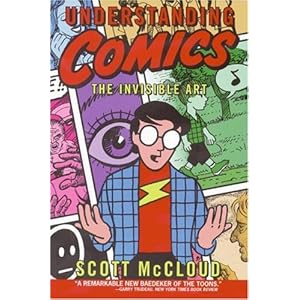
 A year ago I went to Philadephia (some part of it which I don't remember) to go to my cousin and her husband's house to stay over for the night. When I arrived I was flabberghasted (really) because of the enourmous quantity of books they possesed, but I was even more delighted to find out that my niece's husband shared a common like with me: comics. He had bookshelves, stacks on the floor, on top of the fridge - everywhere! I could have spent the rest of the summer right there reading away - but I only had one day. I coincidentially picked this fantastic book about comics. Understanding Comics by Scott McCloud. It really was one of the best comic theory books I've ever read (actually, its the only one I've read -.-)
This book was just so fantastic at explaining the very tight connection between words and pictures - especially in the scan above (my favourite bit) where it mentions Rene Magritte's "Treachery of Images" (another fitting example of images and words working to make you double think if what you are seeing IS a pipe or just a drawing/painting of a pipe).
So enough with that, I picked this comic below to see what i made out of it by just seeing at the images on it.
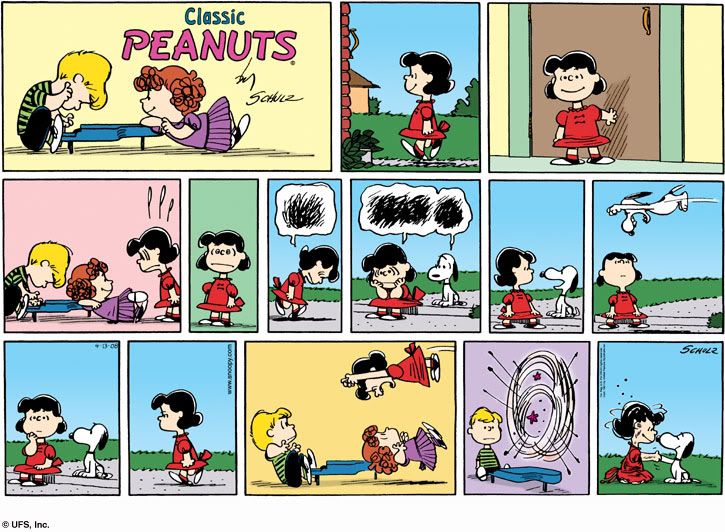
Panel one: Title page. A guy crouched over a piano, playing it/fixing it/sneezing/looking at it for no reason whatsoever/scratching his head/ect. A girl is watching him resting on the piano/she fell on the piano/sniffing the piano/trying to break the piano/etc.
Panel two: A girl walking to a house/ walking towards a brick wall/ hopping on the spot/brushing her feet on the pavement/playing musical statues/etc.
Panel three: A girl gets in a house and shuts the door behind her/she is admiring the door's texture/she supported herself on the door due to dizziness/she is just standing there/etc.
Panel nine: A dog demontrates his plan to attack the other red headed girl/a rabbid dog is attacking the girl/the dog pretends to fly/the dog has been kicked out of his house/etc.
Panel thirteen: A fight between the red headed girl and the girl occurs/their moving so fast around each other it can't even be drawn/a mini storm has appeared on the middle of the room/the artist randomly scribbled the panel/etc.
For me, as a comic artist, I always have to take care on the different poses and faces that I give my charecters so that, when i mix the images with my written script for the comic - it will make some sense for whoever sees it. Sometimes I'm not too successful and people often comment their own take of the comic - which is sometimes quite different from what I initially meant - but its definately a good thing that the people who see it have different views on it. (That, or i really need a lot more practice on it.)
Songs on right now: Crystal Ball - Keane, Supermassive Black Hole - Muse, Every Tear is a Waterfall - Coldplay


